

If you are reading this, you have probably experienced something like this:
Picking up your child from school goes okay. Maybe we ask how their day was, and they say “fine.” Then we get home. And suddenly it hits—the tears, the yelling, the complete meltdown over something that seems very small.
This can happen at any age. From nursery children to teenagers, the pattern is often the same. They hold it together all day in a place that demands a lot from them. Then they get home to their safe spaceA place or environment where a person or group of people can feel comfortable that they will not be discriminated against, harassed, harmed or criticised., and everything they have been holding in comes pouring out.
Take a breath. You are not alone. You are not a bad parent. This is not a tantrum. It is called After-School Restraint Collapse, and it is very common in our neurodivergentAn individual whose brain functions differently from the (usually neurotypical) perception of what is “normal”. For example, an individual with autism, Asperger's syndrome, dyslexia, dyscalculia, dyspraxia, ADHD, OCD or Tourette Syndrome. children.
What exactly is after-school restraint collapse?
Think of our child’s brain as a cup. All day they use huge energy to:
- Mask: Hide stims, force eye contact
- Cope with sensory overload: Lights, noise, crowds
- Process demands: Rules, instructions, social stuff
- Regulate emotions: Keep big feelings contained
By 3 PM, the cup overflows. The moment they hit their safe space—home, with us—the dam breaks. They finally let their guard down. We are safe, so we get the brunt.
What Does It Look Like in Our Homes?
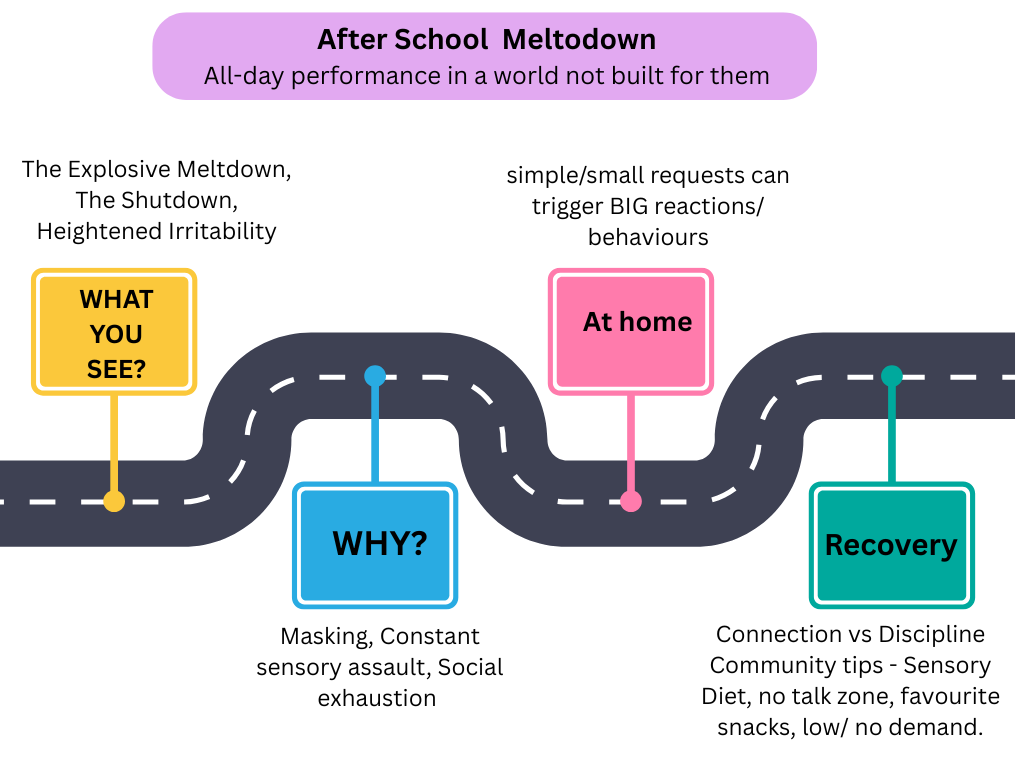
- The Explosive Meltdown: Crying, screaming, throwing
- The Shutdown: Going non-verbal, staring, hiding
- The “Crisis of the Moment”: Shutdown over something tiny
- Heightened Irritability: Everything is annoying, everyone is mean
Why is this so common for our neurodivergent children and young people?
School exhausts everyone. But for our kids—ADHD, autismA complex developmental condition which can significantly affect verbal and non-verbal communication and social interaction in a range of ways., sensory issues, anxiety—it is a whole different level.
- All-day performance in a world not built for them
- Constant sensory assault – imagine a strobe light in your eyes all day
- Social exhaustion – reading subtle social cues is like doing complex maths non-stop.
How we can help our child (and ourselves!) through the collapse
The main thing to remember: the first two hours at home is time for connection, not discipline. Our child is not being difficult. They are struggling.
These tips come from our community. We have tried them in our own homes.
1. The “No-Questions-Asked” Zone (First 30-60 Mins)
- Give snacks, not questions. Favourite snacks handed over silently. Low blood sugar makes things worse.
- Let them pick a low-energy activity. Screen time, fidgets, swinging, weighted blanket, quiet dark room.
- Our job. Stay calm and warm. “I’m so glad you’re home.” Offer a cuddle, don’t push. Just be near them.
2. A gentle way to reconnect
When they seem calmer:
- Do not ask “How was your day?” It makes them re-live stress. Ambiguous questions are difficult to answer.
- Try:
- “I missed you. Show me what you’re making?”
- “Shall we watch that show?”
- “I’m making tea. Hot chocolate?”
- Let them take the lead. Wait for them to come to you.
3. Help them with sensory needs
Many of us find that meeting sensory needs early really helps. Think of this as a daily dose, like vitamins for the nervous system.
What is sensory input?
Our bodies need sensory information to feel calm and regulated. For neurodivergentAn individual whose brain functions differently from the (usually neurotypical) perception of what is “normal”. For example, an individual with autism, Asperger's syndrome, dyslexia, dyscalculia, dyspraxia, ADHD, OCD or Tourette Syndrome. children, these needs can be stronger or different. When these needs are not met, stress builds up. Meeting them helps the nervous system settle.
Think of this as a daily dose.
Some suggestions for sensory input
- Heavy work: Trampoline, pillow fights, carrying laundry, pushing walls, weighted blankets
- Movement: Swinging, rocking, somersaults
- Mouth needs: Chewy snacks, straw cups, chewable jewellery
4. Simple Tips That Help Us
- Talk in the car. Some kids talk easier without eye contact. Just listen, don’t quiz them.
- Get ready the night before. Pack bags, lay out clothes, make lunches. Calm mornings mean less tired kids by afternoon.
A note for us, the parents
Watching this is hard. It leaves us drained and doubly drained if weo urselves are neurodivergentAn individual whose brain functions differently from the (usually neurotypical) perception of what is “normal”. For example, an individual with autism, Asperger's syndrome, dyslexia, dyscalculia, dyspraxia, ADHD, OCD or Tourette Syndrome. and have been doing the same as our child in a neurotypicalThe term given to a group of people or an individual who is not neurodivergent, and who does not have a condition such as Asperger's syndrome, dyslexia, dyscalculia, dyspraxia, ADHD, OCD or Tourette Syndrome. environment all day.
Validate Our Own Feelings: It’s okay to be tired. This is hard for you too.
- We Are Their Safe Harbour: The fact they collapse with you shows deep trust. That matters.
- Find Our Own Support: Talk to other NeurodivergentAn individual whose brain functions differently from the (usually neurotypical) perception of what is “normal”. For example, an individual with autism, Asperger's syndrome, dyslexia, dyscalculia, dyspraxia, ADHD, OCD or Tourette Syndrome. parents. Join communities. Your cup needs refilling too.
A quick note before you go
Every family is different. Every child is unique. These tips are simply things our community has tried and tested. What works for one may not work for another. Take what feels useful, leave the rest.
After-school restraint collapse is not bad behaviour. It means our children have worked incredibly hard to cope.
When they fall apart at home, it is because they feel safe with us.
So let’s try to be patient. Hold that space for them.
But be kind to yourself on hard days. Some days you will lose your cool. Some days your own cup overflows. That is okay. You are human. You are doing this without the safe spaceA place or environment where a person or group of people can feel comfortable that they will not be discriminated against, harassed, harmed or criticised. you give them.
We show up for them. We try to show up for ourselves too.
Need more support?
We are here to help.
- One-to-one support tailored to your family – Book your Free Discovery Call – https://tidycal.com/yaso/discovery-session-neurotribe-uk
- Read More from Our Blog –https://neurotribe.uk/blog/
Here at Neurotribe our team are NeurodivergentAn individual whose brain functions differently from the (usually neurotypical) perception of what is “normal”. For example, an individual with autism, Asperger's syndrome, dyslexia, dyscalculia, dyspraxia, ADHD, OCD or Tourette Syndrome. parent-carers themselves; to book an assessment call or to find out more about therapy click here https://calendar.app.google/vDWrH9JsLRmoeYUa8