The journey to understanding our child’s neurodivergence starts in different ways for every parent. For some of us, it begins with that sinking feeling after yet another parent-teacher meeting, where concerns about our child’s focus or social skills keep mounting. For others, it’s the persistent comments from family members who keep saying “they’ll grow out of it” or “all children are like that.” Sometimes, it’s the school’s SENCO who first suggests an assessment. Wherever our starting point, receiving that official diagnosis – whether it’s ADHD, AutismA complex developmental condition which can significantly affect verbal and non-verbal communication and social interaction in a range of ways., DyslexiaA condition that involves difficulty in learning to read or interpret letters, words and other symbols. or another profile – marks the beginning of a new chapter filled with complex emotions and important realisations.
What we’re feeling is not just normal – it’s part of a process that many parents before us have navigated. AcceptanceThe act of taking, receiving or agreeing with something without attempting to change or protest it. doesn’t happen in a straight line, and understanding these five stages can help us be gentler with ourselves as we move through this journey.
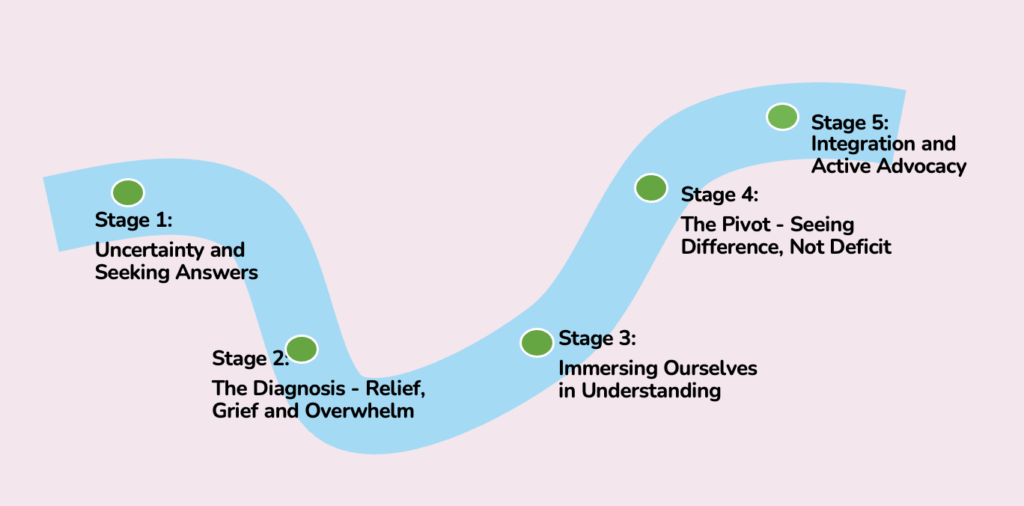
Stage 1: Uncertainty and Seeking Answers
Before the diagnosis, many of us spend months or even years in this stage. It’s that nagging sense that something doesn’t quite fit, even when others dismiss our concerns. We might find ourselves scrolling through parenting forums late at night, reading article after article, trying to understand why our bright child struggles so much with certain tasks. This stage is characterised by that relentless search for clarity, often feeling alone in our observations while simultaneously hoping we’re wrong.
Stage 2: The Diagnosis – Relief, Grief and Overwhelm
When the diagnosis comes, it often brings conflicting emotions that can leave us feeling emotionally whiplashed. There’s frequently profound relief – finally having a name for what we’ve been observing validates our parental instincts and ends the uncertainty. But this relief often coexists with grief – for the “typical” childhood we imagined, for the future we’d pictured, and sometimes for the parenting experience we thought we’d have. The weight of new information and terminology can feel paralysing, leaving us wondering where to even begin.
Stage 3: Immersing Ourselves in Understanding
Driven by love and that deep parental need to do right by our children, we dive into learning everything we can. We become experts overnight – reading books, attending webinars, joining support groups, and learning about educational rights and support systems. While this intensive learning phase is empowering, it’s also where many of us risk burning out. The key during this stage is remembering that we don’t need to know everything at once, and that finding reliable sources and communities is more valuable than trying to absorb all the information at once.
Stage 4: The Pivot – Seeing Difference, Not Deficit
This is where our perspective truly begins to transform. We start to move beyond seeing neurodivergence as a list of challenges and begin to appreciate it as a different way of experiencing the world. We learn to reframe what we once saw as “problem behaviours” – understanding that meltdowns might signal sensory overwhelm, or that resistance to certain activities might reflect anxiety rather than defiance. We begin to recognise and celebrate our child’s unique strengths – their incredible memory, their passionate interests, their unique perspective and honesty.
Stage 5: Integration and Active AdvocacyThe act of publicly supporting or recommending a particular cause, enabling others to have their voices heard.
AcceptanceThe act of taking, receiving or agreeing with something without attempting to change or protest it. becomes something we live and practice daily in this final stage. It’s not about “moving on” from the diagnosis but about weaving this understanding into the very fabric of our family life. We become confident advocates for our children, working collaboratively with schools to ensure proper support. We stop trying to force our children into neurotypicalThe term given to a group of people or an individual who is not neurodivergent, and who does not have a condition such as Asperger's syndrome, dyslexia, dyscalculia, dyspraxia, ADHD, OCD or Tourette Syndrome. moulds and instead focus on creating environments where they can thrive as their authentic selves. Most importantly, we find our tribe – other families who understand this journey without needing explanation.
Navigating This Journey Together
It’s crucial to remember that these stages aren’t linear. We might feel solid in our acceptanceThe act of taking, receiving or agreeing with something without attempting to change or protest it. one day, only to be thrown back into grief or uncertainty the next when facing new challenges. A difficult school meeting, a misunderstood social situation, or unsolicited advice from well-meaning relatives can trigger old feelings. This doesn’t mean we’ve failed or gone backwards – it means we’re human, navigating a complex journey.
What matters most is that we extend the same compassion to ourselves that we so readily offer our children. This journey transforms us just as much as it supports our children. We’re learning to see the world through a different lens, to appreciate neurodiversityHow human brains and minds differ. The Neurodiversity Movement is an approach that seeks equal rights, respect and inclusion for neurodivergent people who have conditions like autism, Asperger's syndrome, dyslexia, dyscalculia, dyspraxia, ADHD, OCD or Tourette Syndrome, and to champion our children’s right to be exactly who they are. In doing so, we’re not just accepting a diagnosis – we’re learning to truly see, understand and celebrate our wonderful, neurodivergentAn individual whose brain functions differently from the (usually neurotypical) perception of what is “normal”. For example, an individual with autism, Asperger's syndrome, dyslexia, dyscalculia, dyspraxia, ADHD, OCD or Tourette Syndrome. children in all their unique glory.