

We all know the feeling. One minute our child is happy. Next, we say it is time to leave. Suddenly, they are on the floor crying.
For a long time, we thought this was bad behaviour. Then we learned about transitions. It changed everything.
What Is a Transition?
A transition is any time we switch from one thing to another. It can be a big change, like starting a new school. But mostly, it is the small moments in our day.
Things like:
- Waking up
- Stopping a game
- Getting in the car
- Turning off the tablet
Let us give you an example that quite a few of us are very familiar with:
Ending screen time is one of the hardest transitions for our family. Our child loves their tablet. When we said “time to stop,” there would be shouting, crying, and sometimes throwing the tablet. We did not understand why. They knew the rule. But we learned that stopping something they love feels like a huge loss. Their brain cannot just switch off.
Now we know that this reaction is not defiance. It is a sign that their brain needs more support to make the switch.
For neurotypicalThe term given to a group of people or an individual who is not neurodivergent, and who does not have a condition such as Asperger's syndrome, dyslexia, dyscalculia, dyspraxia, ADHD, OCD or Tourette Syndrome. people, these switches are easy. For our neurodivergentAn individual whose brain functions differently from the (usually neurotypical) perception of what is “normal”. For example, an individual with autism, Asperger's syndrome, dyslexia, dyscalculia, dyspraxia, ADHD, OCD or Tourette Syndrome. children, they can feel like hitting a brick wall. Their brains cannot slide from one thing to the next. They have to stop, crash, and try to start again.
This is not stubbornness. It is how their brain works.
What Does It Look Like?
When our child struggles with a transition, it might look like:
- Hitting or screaming when we ask them to stop
- Running away
- Being very silly or wild
- Going completely still
- Having a meltdown after we arrive somewhere new
We realised our child was not trying to ruin our trip. They were trying to survive the change.
What Can We Do? Tips from Our Community
We have learned so much from other neurodivergentAn individual whose brain functions differently from the (usually neurotypical) perception of what is “normal”. For example, an individual with autism, Asperger's syndrome, dyslexia, dyscalculia, dyspraxia, ADHD, OCD or Tourette Syndrome. parents and from neurodivergentAn individual whose brain functions differently from the (usually neurotypical) perception of what is “normal”. For example, an individual with autism, Asperger's syndrome, dyslexia, dyscalculia, dyspraxia, ADHD, OCD or Tourette Syndrome. adults. They have shared what works for their families.
A quick note before we start:
These tips are suggestions from our community, not rules. Every child is different. What works for one family might not work for yours. Some tips might work today but not tomorrow. That is okay. Think of these as a starting point. Pick one thing to try. If it does not work, try something else. You know your child best.
Here are the tips we use every day.
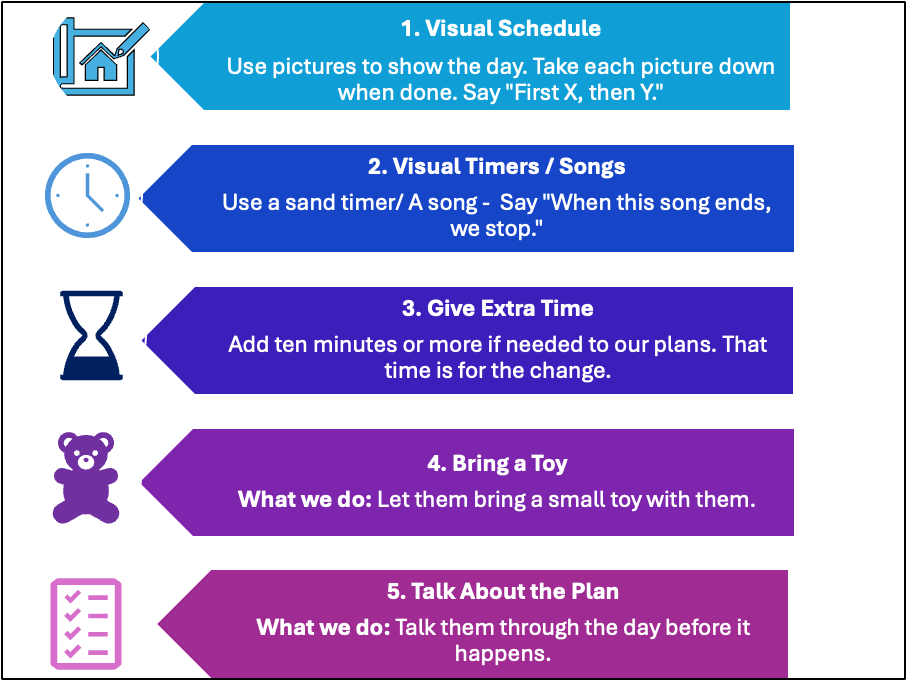
1. Use a Visual Schedule with “First / Then”
Our children feel lost when they do not know what comes next.
What we do: We use pictures to show each part of the day. When we finish one thing, we take the picture down. Then we use “first / then” to make the next step clear. We say: “First we put on our coat, then we watch Bluey.”
Why it helps: Our child can see what comes next. The world feels more predictable. And their brain has something to look forward to. They are not just stopping something fun. They are moving towards something good.
2. Use Visual Timers
Saying “five more minutes” does not mean much to them.
What we do: We use sand timers. We say: “When this song ends, we put our shoes on.”
Why it helps: When they see time running out, the change is less of a shock.
3. Give Extra Time
Rushing makes transitions harder.
What we do: We add ten minutes to our plans. That time is for the change itself.
Why it helps: Extra time gives us space if a meltdown happens. We are not shouting and stressing while our child tries to switch gears.
4. Bring a Toy
Sometimes they cannot leave a world until they bring a piece of it with them.
What we do: We let them bring a small toy. If they are playing with dinosaurs, one dinosaur comes to the car.
Why it helps: This is not spoiling them. It is a bridge. It helps their body feel safe during the change.
5. Talk About the Plan
Our children need to hear the plan.
What we do: We talk them through the day. “In ten minutes, we will pause the show. Then we get our coats and walk to the car.”
Why it helps: Even if they do not look at us, they are listening. It helps their brain map out what is coming.
What We Have Learned
We stopped thinking our child was giving us a hard time. We realised they were having a hard time.
When we stop asking “Why will you not do what I say?” and start asking “What does your body need?” everything gets easier.
We still have hard days. But we do not take it personally anymore.
If you are in the middle of this, take a breath. You are not a bad parent. Your child is not a bad child. You are both learning together.
A Quick Note Before You Go
Every family is different. Every child is unique. These tips are simply things our community has tried and tested. What works for one may not work for another. Take what feels useful, leave the rest.
So let us try to be patient. Let us hold that space for our children; but let us also be kind to ourselves on hard days. Some days we will lose our cool. Some days our own cup overflows. That is okay. We are human. We are doing this without the safe spaceA place or environment where a person or group of people can feel comfortable that they will not be discriminated against, harassed, harmed or criticised. we give them.
We show up for them. We try to show up for ourselves too.
Need More Support?
We are here to help.
- One-to-one support tailored to your family – Book your Free Discovery Call
- Read more from our blog – https://neurotribe.uk/blog/
Here at Neurotribe, our team are neurodivergentAn individual whose brain functions differently from the (usually neurotypical) perception of what is “normal”. For example, an individual with autism, Asperger's syndrome, dyslexia, dyscalculia, dyspraxia, ADHD, OCD or Tourette Syndrome. parent-carers themselves. We have struggled with the same issues. We are here to support parent-carers with a safe, non-judgemental, confidential space. We can help you avoid burnoutA stress condition where we feel overwhelmed, emotionally drained and unable to keep up with the demands of our daily life..