

If you’ve ever picked your child up from school only to be greeted by a meltdown the second they walk through the door, you might have found yourself thinking: “Who is this child?”
Not because they’ve been naughty, but because the polite, quiet, rule-following child the teacher describes at parents’ evening bears absolutely no resemblance to the loud, explosive, or emotionally fragile child you live with at home.
You are not alone. And you are not doing anything wrong. You might just be witnessing a phenomenon called maskingThe act of changing or ‘hiding’ natural behaviours to appear “normal”. This action can be conscious or unconscious, and is often used in a situation that is threatening in some way. For example, a person may attempt to appear more ‘neurotypical’ to avoid bullying at school or work. .
The Two Different Worlds
It starts with a phone call from the school. “Everything is fine,” the teacher assures you. “They’re a pleasure to have in class. Very well behaved.”
You hang up and stare at the living room, which looks like a tornado has just hit it. Your child, who apparently sat cross-legged and silent for six hours, is now lying on the floor sobbing because their toast is cut into squares instead of triangles.
The guilt creeps in. Is it me? Am I not strict enough? Do they only act out for me?
The answer is almost certainly no. What you are seeing is the cost of holding it together all day.
What is MaskingThe act of changing or ‘hiding’ natural behaviours to appear “normal”. This action can be conscious or unconscious, and is often used in a situation that is threatening in some way. For example, a person may attempt to appear more ‘neurotypical’ to avoid bullying at school or work. ?
In neurodivergentAn individual whose brain functions differently from the (usually neurotypical) perception of what is “normal”. For example, an individual with autism, Asperger's syndrome, dyslexia, dyscalculia, dyspraxia, ADHD, OCD or Tourette Syndrome. children (those with ADHD, AutismA complex developmental condition which can significantly affect verbal and non-verbal communication and social interaction in a range of ways., or other sensory processing differences), masking—also known as “camouflaging”—is an instinctive survival strategy. It is the conscious or unconscious suppression of natural behaviours to fit into a neurotypicalThe term given to a group of people or an individual who is not neurodivergent, and who does not have a condition such as Asperger's syndrome, dyslexia, dyscalculia, dyspraxia, ADHD, OCD or Tourette Syndrome. environment.
At school, your child may be:
- Forcing themselves to make eye contact even when it feels like sand in their eyes.
- Sitting perfectly still while their internal motor is screaming to run.
- Swallowing sensory discomfort (the bright lights, the scratchy uniform, the smell of the canteen).
- Mimicking other children’s facial expressions so they don’t look “weird.”
They are essentially acting in a play, eight hours a day, without a script or a break.
The “After-School Restraint Collapse”
You might know this as the 3:30pm explosion. Psychologists often call it the “after-school restraint collapse.”
Imagine holding a beach ball under water. You can do it for a minute or two. You might even manage an hour if you try really hard. But the second you relax your arms, that ball is launching into the stratosphere.
For your child, school is the act of holding the beach ball under water. They suppress their instincts, ignore their sensory needs, and perform “being okay” for the teachers and peers.
The second they see you—their safe person—the arms give way. The meltdown, the rudeness, the hyperactivity, or the sudden withdrawal isn’t a sign that they are naughty. It is a sign that they feel safe enough to be broken with you.
Not all children mask the same way. Look for these common patterns:
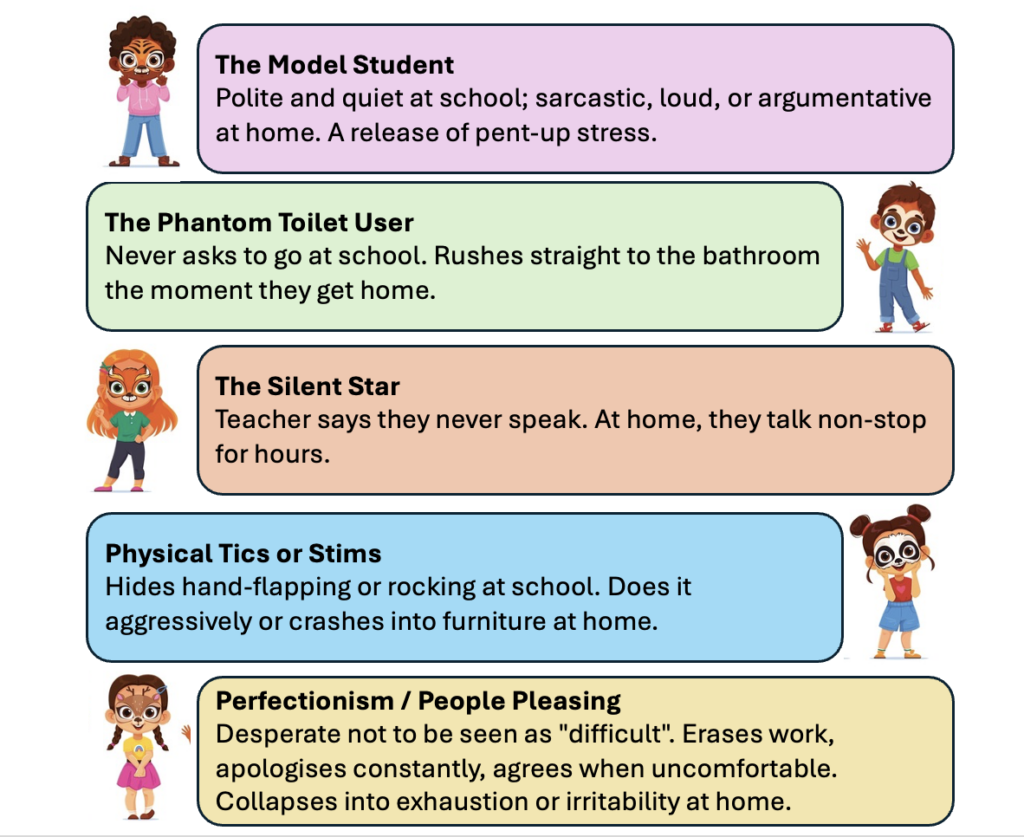
- The Model Student: At school, they are polite, quiet, and never answer back. Teachers describe them as a “pleasure to have in class.” At home, they are sarcastic, loud, or argumentative. This contrast is often a release of pent-up stress from holding it together all day.
- The Phantom Toilet User: They never ask to go to the loo at school because they don’t want the attention. They come home and rush straight to the bathroom.
- The Silent Star: The teacher says they never speak. At home, they won’t stop talking about Minecraft lore for three hours straight.
- Physical tics or stimming: They hide their hand-flapping or rocking at school, only to do it aggressively (or crash into furniture) the moment they get home.
- Perfectionism / People Pleasing: They are desperate not to be seen as ‘difficult’ or ‘different’. They may erase work repeatedly until it’s flawless, apologise constantly for small mistakes, or agree with peers even when they feel uncomfortable. This need to please everyone at school often collapses into exhaustion or irritability once they are home.
Why This Matters (And Why You Shouldn’t Stop It)
When we first realise our child is maskingThe act of changing or ‘hiding’ natural behaviours to appear “normal”. This action can be conscious or unconscious, and is often used in a situation that is threatening in some way. For example, a person may attempt to appear more ‘neurotypical’ to avoid bullying at school or work. , our parental instinct is often to say: “Stop pretending. Just be yourself.”
But maskingThe act of changing or ‘hiding’ natural behaviours to appear “normal”. This action can be conscious or unconscious, and is often used in a situation that is threatening in some way. For example, a person may attempt to appear more ‘neurotypical’ to avoid bullying at school or work. isn’t a choice. For many neurodivergentAn individual whose brain functions differently from the (usually neurotypical) perception of what is “normal”. For example, an individual with autism, Asperger's syndrome, dyslexia, dyscalculia, dyspraxia, ADHD, OCD or Tourette Syndrome. children, they literally do not know how to be themselves in a setting like a UK primary school, where conformity is often rewarded over comfort.
The danger isn’t the mask itself. The danger is when the mask never comes off.
BurnoutA stress condition where we feel overwhelmed, emotionally drained and unable to keep up with the demands of our daily life. happens when a child masks so heavily, for so long, that they exhaust their nervous system. This leads to school refusal, anxiety disorders, selective mutism, or depression—often by Year 5 or Year 6.
How to Support Your ‘Two Different’ Children
You cannot change the school system overnight, but you can change how you respond to the crash.
1. Stop the “How Was School?” interrogation
For a maskingThe act of changing or ‘hiding’ natural behaviours to appear “normal”. This action can be conscious or unconscious, and is often used in a situation that is threatening in some way. For example, a person may attempt to appear more ‘neurotypical’ to avoid bullying at school or work. child, reliving the day is torture. Replace it with quiet connection. A cuddle, a snack, ten minutes of iPad time in the dark. Let them come to you.
2. Create a low-demand zone
The hour after school should have zero demands. No “take your shoes off properly.” No “eat your vegetables.” No “did you get your reading record signed?” Just survival and safety.
3. Validate the crash
When they are screaming because the toast is wrong, don’t say, “Stop it, you’re fine.” Say, “I see you. That was a really long day. You held it together for so long. Let it out.”
4. Communicate with the school (carefully)
Tell the SENCO (Special Educational Needs Co-ordinator): “My child is exhausted by maskingThe act of changing or ‘hiding’ natural behaviours to appear “normal”. This action can be conscious or unconscious, and is often used in a situation that is threatening in some way. For example, a person may attempt to appear more ‘neurotypical’ to avoid bullying at school or work. . Can we build in sensory breaks? Can they wear ear defenders? Can handwriting be reduced to save energy?” You want the school to help lower the mask, not force them to wear a better one.
A final word to the exhausted parent
If your child is a “different person” at school, it means you have done something right. It means you have built a home that is safe enough for them to remove the armour they wear for the outside world.
The child at school is performing. The child at home is real.
Hold the real one close. The meltdowns will ease when the mask gets lighter. And that starts with you believing them, not doubting yourself.
A Quick Note Before You Go
Every family is different. Every child is unique. These tips are simply things our community has tried and tested. What works for one may not work for another. Take what feels useful, leave the rest.
So let us try to be patient. Let us hold that space for our children; but let us also be kind to ourselves on hard days. Some days we will lose our cool. Some days our own cup overflows. That is okay. We are human. We are doing this without the safe spaceA place or environment where a person or group of people can feel comfortable that they will not be discriminated against, harassed, harmed or criticised. we give them.
We show up for them. We try to show up for ourselves too.
Need More Support?
We are here to help.
- One-to-one support tailored to your family – Book your Free Discovery Call
- Read more from our blog – https://neurotribe.uk/blog/
Here at Neurotribe, our team are neurodivergentAn individual whose brain functions differently from the (usually neurotypical) perception of what is “normal”. For example, an individual with autism, Asperger's syndrome, dyslexia, dyscalculia, dyspraxia, ADHD, OCD or Tourette Syndrome. parent-carers themselves. We have struggled with the same issues. We are here to support parent-carers with a safe, non-judgemental, confidential space. We can help you avoid burnoutA stress condition where we feel overwhelmed, emotionally drained and unable to keep up with the demands of our daily life..