

Real tips for real neurodivergentAn individual whose brain functions differently from the (usually neurotypical) perception of what is “normal”. For example, an individual with autism, Asperger's syndrome, dyslexia, dyscalculia, dyspraxia, ADHD, OCD or Tourette Syndrome. homes – less stress, more connection.
If you’re raising a neurodivergentAn individual whose brain functions differently from the (usually neurotypical) perception of what is “normal”. For example, an individual with autism, Asperger's syndrome, dyslexia, dyscalculia, dyspraxia, ADHD, OCD or Tourette Syndrome. child (autistic, ADHD, PDA, or otherwise wonderfully wired), you already know normal parenting advice often doesn’t fit.
Reward charts feel like pressure. Time-outs make things worse. Telling your child to “calm down” can trigger a meltdown.Mainstream methods focus on obedience, not connection. They assume your child won’t behave, instead of seeing that your child can’t behave right now. Strength-based parenting works with your child’s brain.
What This Approach Means
Instead of “What’s wrong with my child?” … ask “What’s hard for my child right now, and what skill can we build together?”
Your child’s intense focus isn’t “stuck” – it’s deep interest. Refusal isn’t “defiance” – it might be overwhelm. A meltdown isn’t “bad behaviour” – it’s a flooded nervous system. When you lead with strengths, understanding replaces fixing. That understanding is connection.
Simple Daily Rituals
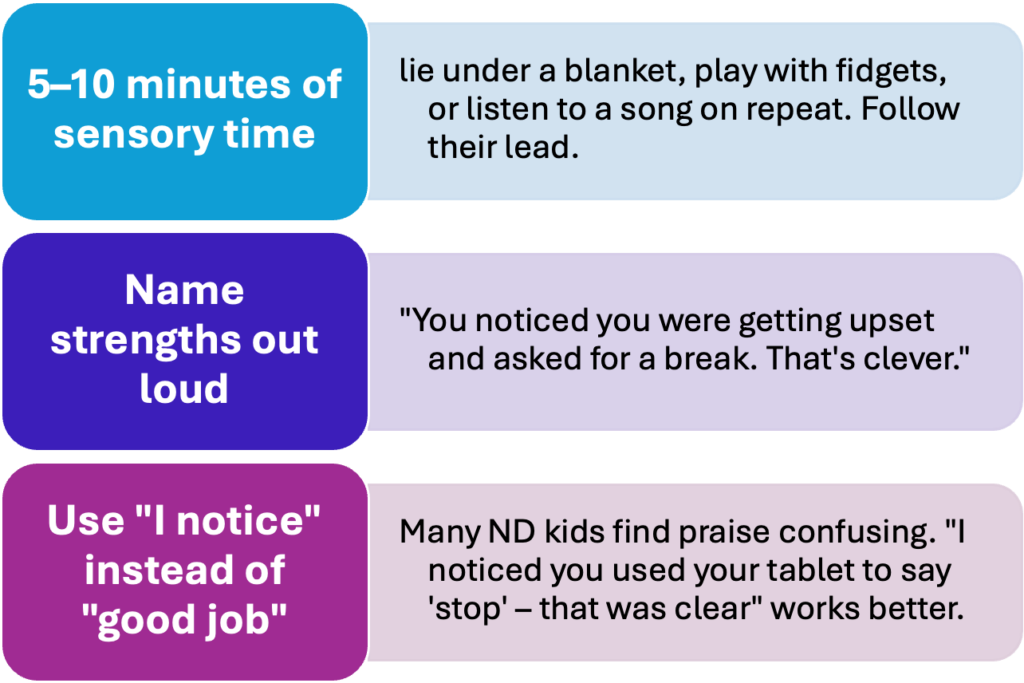
Repair Is Everything (and You Will Need It)
You will lose your cool. That’s not failure – it’s human.
Repair is your most important skill:
- Say it – “I shouted. That wasn’t fair.”
- Own it – “That was my problem, not yours.”
- Reconnect – “I love you. Let’s start again.”
Repair teaches more than perfection ever could. Ruptures can be fixed, and love stays.
Tips From Our Community of ND Parents
We asked: “What’s one tip that actually works in your ND home?”
“I stopped asking ‘why’ and started asking ‘what.’ ‘Why did you hit?’ assumes intent. ‘What happened just before?’ is facts.” – Jess, mum of a PDA child
“We use low-demand breaks. Stop everything for 20 minutes. Snacks, screens, quiet. Stops most meltdowns.” – Alex, autistic parent of two ADHD kids
“I stopped forcing eye contact. ‘You can listen with your ears or your body. I trust you.’ My son actually hears me now.” – *Tanya, mum of an autistic 7-year-old*
“When my daughter goes non-speaking during a meltdown, I sit nearby and say, ‘You’re having a hard time. I’m not leaving.’ That changed everything.” – Marcus, dad with ADHD
“We replaced ‘calm down’ with ‘Do you want pressure, space, or movement?’ Covers nearly every sensory need.” – Erin, mum with SPD“I parent my own feelings first. ‘Mum needs her ear defenders for five minutes. You’re safe.’ Showing a shutdown teaches self-kindness.” – Sam, AuDHD parent
Discipline Without Shame
| Instead of… | Try this… |
| “Go to your room.” | “You’re overwhelmed. I’ll sit nearby until it passes.” |
| “You have to do it now.” | “I see the ‘no.’ Let’s try one tiny step or come back later.” |
| “That was bad.” | “Hitting means ‘I’m overwhelmed.’ What does your body need?” |
The goal isn’t obedience. It’s safety, connection, and your child understanding themselves.
A Note for ND Parents
You are part of this too.
You’re not failing because you get overwhelmed. You’re not weak because you need headphones. You’re not a bad parent because you’ve shouted.Strength-based parenting means seeing your strengths – your persistence, your love, your willingness to learn a different way. You can’t help your child calm down if you’re flooded. Take the break. You matter too.
One Last Thing from Our Community
As one parent said:
“I stopped trying to raise a ‘well-behaved’ child. I started trying to raise a child who knows they are good – exactly as they are. The behaviour got easier after that. Not because they changed. Because I did.”
That’s strength-based. That’s connection-focused. That’s ND family wisdom.
A Quick Note Before You Go
Every family is different. Every child is unique. These tips are simply things our community has tried and tested. What works for one may not work for another. Take what feels useful, leave the rest.
So let us try to be patient. Let us hold that space for our children; but let us also be kind to ourselves on hard days. Some days we will lose our cool. Some days our own cup overflows. That is okay. We are human. We are doing this without the safe spaceA place or environment where a person or group of people can feel comfortable that they will not be discriminated against, harassed, harmed or criticised. we give them.
We show up for them. We try to show up for ourselves too.
Need More Support?
We are here to help.
- One-to-one support tailored to your family – Book your Free Discovery Call
- Read more from our blog – https://neurotribe.uk/blog/
Here at Neurotribe, many of our team are neurodivergentAn individual whose brain functions differently from the (usually neurotypical) perception of what is “normal”. For example, an individual with autism, Asperger's syndrome, dyslexia, dyscalculia, dyspraxia, ADHD, OCD or Tourette Syndrome. parent-carers themselves. We have struggled with the same issues. We are here to support parent-carers with a safe, non-judgemental, confidential space. We can help you avoid burnoutA stress condition where we feel overwhelmed, emotionally drained and unable to keep up with the demands of our daily life..